
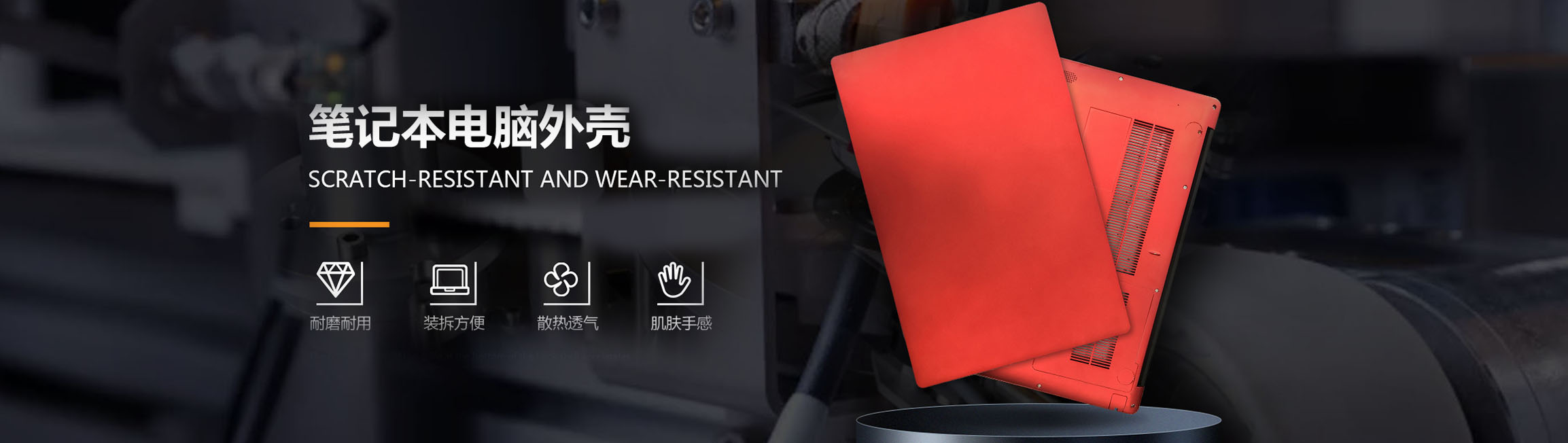
The main materials and advantages and disadvantages of laptop casings
The main materials and advantages and disadvantages of laptop casings
Reinforcing the shell of a laptop is not only a direct way to protect the body, but also an important factor affecting its cooling effect, "weight" and aesthetics. Common shell materials for notebook computers are: alloy shells are aluminum-magnesium alloys and titanium alloys, and plastic shells are carbon fiber, polycarbonate PC, and ABS engineering plastics.
Aluminum-magnesium alloy: The main element of aluminum-magnesium alloy is aluminum, and then a small amount of magnesium or other metal materials are added to enhance its hardness. Because it is a metal itself, its thermal conductivity and strong are particularly outstanding. Aluminum-magnesium alloy is light in weight, low in density, good in heat dissipation and strong in compression resistance, which can fully meet the requirements of highly integrated, thin and microscopic 3C products. Appearance, drop resistance, electromagnetic shielding, heat dissipation and other requirements. It is several times harder than traditional plastic casings, but only one-third the weight.
High-end ultra-thin or smaller laptop case. And the silver-white magnesium-aluminum alloy shell can make the product more luxurious, beautiful and easy to color. Through the surface treatment process, it becomes personalized powder blue and pink, adding a lot of color to the notebook, which is incomparable with engineering plastics and carbon fiber. Therefore, aluminum-magnesium alloy has become the shell material of portable notebook computers, and most of the notebook computer products of manufacturers use aluminum-magnesium alloy shell technology. Disadvantages: Magnesium-aluminum alloy is not very strong and wear-resistant, higher cost, more expensive, and more difficult to form than ABS (requires stamping or die-casting process), so pen notebook computers generally only use aluminum-magnesium alloy on the top cover, rarely Models use an aluminum-magnesium alloy to make the entire case.
Titanium alloy:
Titanium alloy material can be said to be an enhanced version of aluminum-magnesium alloy. In addition to the difference between titanium and magnesium alloys, the bigger difference is that it also penetrates into the metal itself. Carbon fiber materials are superior to aluminum-magnesium alloy materials in terms of heat dissipation, strength and surface texture, have better processing performance, and have a more complex appearance than aluminum-magnesium alloys. Change. Its key breakthrough is stronger toughness and thinner. Titanium alloys are three to four times stronger than magnesium alloys in terms of strength and toughness. The higher the toughness, the more durable the higher the pressure, and the better it can support large-size displays. Therefore, even though the titanium model is equipped with a 15-inch display, there is no need to reserve around the panel. Frame is too wide. In terms of thinness, the thickness of titanium alloy is only 0.5mm, which is half that of magnesium alloy, and halving the thickness can make the notebook more petite. The disadvantage of titanium alloys is that complex structures such as welding can be used to make laptop casings with complex structures. These production processes have derived considerable costs and are therefore very expensive. As of 2013, other titanium composites in the titanium composite grade are still IBM's proprietary materials, and IBM laptops are more expensive. one of the reasons.
carbon fiber:
Carbon fiber material is a very interesting material, it not only has the elegant and strong characteristics of aluminum-magnesium alloy, but also has the high plasticity of ABS engineering plastic. It looks like plastic, but it is stronger and thermally conductive than regular ABS plastic, and carbon fiber is a conductive material that acts as a shield similar to metal (ABS). The housing needs an additional coating of metal film to shield). Therefore, as early as April 1998, IBM was the first to launch a notebook computer with a carbon fiber shell, and IBM has been the protagonist of vigorous promotion. According to the data of 1BM company, the toughness of carbon fiber is twice that of aluminum-magnesium alloy, and the heat dissipation effect is good. If used at the same time, the shell of the carbon fiber model does not feel hot to the touch. The disadvantage of carbon fiber is that it is more expensive and not as easy to mold as ABS shells. The shape is generally relatively simple, lacks variation, and the color is more difficult. In addition, the carbon fiber chassis has a disadvantage that if the grounding is not good, there will be a slight leakage inductance, so IBM covered its carbon fiber chassis with an insulating coating.
Polycarbonate PC: It is one of the materials used for laptop casings. Its raw material is petroleum. After processing